
Automated report. This article was drafted by software from the sources listed below, checked automatically against them, and read by the editor, Sam Allcock, before it was published. Law Week labels every article produced this way. A person is answerable for it: if something here is wrong, write to editor@lawweek.co.uk and we will correct it on the page and say what changed.
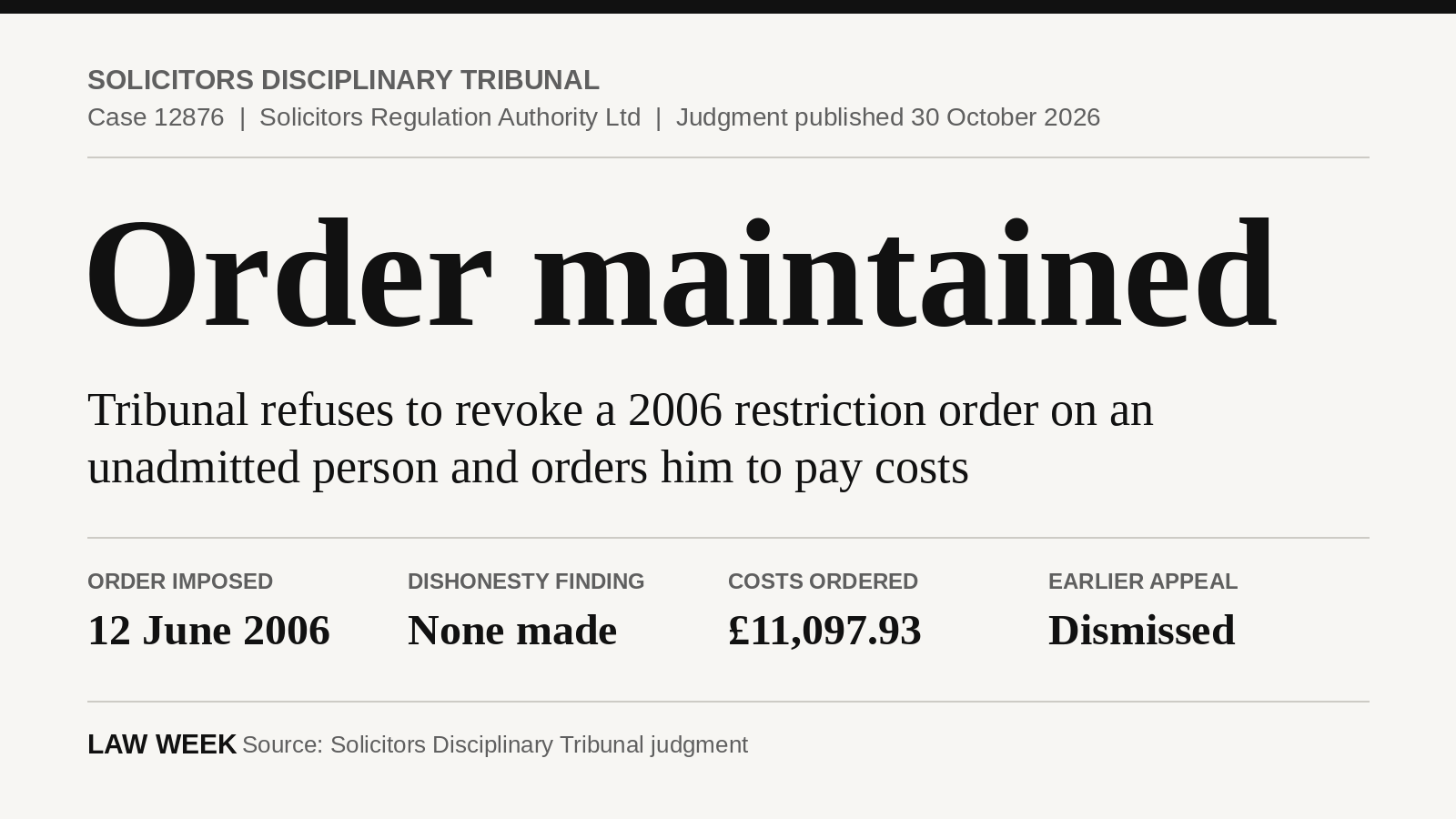
The Solicitors Disciplinary Tribunal has refused an application by Kevin Edwin Francis Gregory, an unadmitted person, to review and revoke a section 43 order made against him in 2006, in a judgment dated 27 October 2026.
The tribunal found that Mr Gregory had not established any basis to quash, vary or disturb the order, and that he had not shown that its continuation was no longer necessary for the protection of the public and the maintenance of confidence in the solicitors’ profession. The tribunal ordered Mr Gregory to pay costs of £11,097.93 to the Solicitors Regulation Authority Ltd.
Key points
- The section 43 order was originally imposed on 12 June 2006 after the tribunal found Mr Gregory had represented himself as a solicitor, trainee solicitor or acting solicitor when he was not, and had pursued a claim for costs he knew or ought to have known was incapable of justification.
- No finding of dishonesty was made against Mr Gregory in the original proceedings.
- Mr Gregory’s earlier appeal to the Divisional Court and subsequent application to the Court of Appeal were both unsuccessful.
- At the outset of the hearing on 30 September 2026, the tribunal refused Mr Gregory’s application to adjourn, after which he withdrew from participating further but did not withdraw the substantive application.
- The tribunal noted that Mr Gregory had since been subject to General Civil Restraint Orders, proceedings under section 44BB of the Solicitors Act 1974, and a director disqualification order that remained in force.
The review application
Mr Gregory argued that the tribunal lacked jurisdiction to impose the 2006 order because he was neither employed nor remunerated by a solicitor, that the tribunal had misdirected itself in law, that it had reversed an earlier conclusion without new evidence, that he had not been given a proper opportunity to present mitigation, and that the tribunal had proceeded on a mistaken understanding of his regulatory status.
The tribunal found that these issues had already been considered and rejected by the Divisional Court and in Mr Gregory’s unsuccessful attempt to appeal further. It noted that leading counsel who had represented Mr Gregory before the 2006 tribunal had proceeded on the basis, treated as common ground, that he was employed or remunerated by a solicitor. The tribunal concluded the review application could not succeed.
The revocation application
Mr Gregory submitted that no finding of dishonesty had been made against him, that around twenty years had passed since the order was imposed, and that he had not faced further disciplinary proceedings since. The tribunal accepted these were relevant considerations but said they were not determinative.
The Solicitors Regulation Authority Ltd pointed to General Civil Restraint Orders, section 44BB proceedings and a director disqualification order made against Mr Gregory since 2006. The tribunal said it did not treat these as conclusive proof of the underlying facts, but found them relevant to assessing continuing regulatory control and public protection. It concluded the later court orders supported the view that continuation of regulatory safeguards remained necessary, and that Mr Gregory had failed to discharge the burden of showing the order should be revoked.
Outcome
The tribunal ordered that Mr Gregory’s application for revocation of the section 43 order be refused, and that he pay costs of £11,097.93. The tribunal considered Mr Gregory’s oral evidence that he received state benefits and financial help from his brother, but said that in the absence of documentary evidence of his means, this did not justify reducing the costs sum claimed.
Mr Gregory may appeal the tribunal’s decision to the High Court.